
China Banned Crypto, But Chinese P2P Transactions Just Exploded 3.5x. Here’s Why

A recent study has revealed that peer-to-peer (P2P) transactions among Chinese users have grown 3.5-fold in the past year despite the nation’s relentless crypto ban.
According to Blockchain intelligence firm Chainalysis, the Chinese are utilizing these P2P transactions as a workaround to the heavily restricted centralized crypto operations.
Latest statistics on China crypto growth
In the past two years, the Chinese have moved over $176 billion in crypto transactions. This was largely driven by a massive 43x growth in stablecoin turnover between Q1 2024 and Q2 2026, all happening in informal underground and over-the-counter platforms.
Additionally, starting in March 2025, the number of relatively small transactions grew tremendously. Transactions under $100 grew 996%, those between $100-$1,000 grew 1057%, and those between $1,000-$10,000 grew 1,321%.


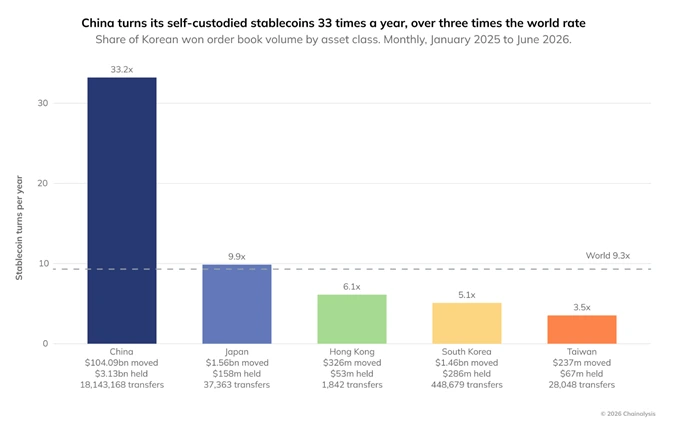
Even more, during the same period, analysts recorded 18.1 million P2P stablecoin transactions moving a total of $104.1 billion.
Furthermore, China recorded 33.2x annual stablecoin turnover, which is quite substantial as compared to the global average of 9.3x.
These numbers indicate China is predominantly utilizing stablecoins as a means of payment, rather than assets held as savings. Users also turned to it following the 2025 expansion of the social credit system – an initiative that monitors individuals’ and entities’ trustworthiness. Stablecoins bypass this government oversight, in addition to crypto restrictions in legacy systems.
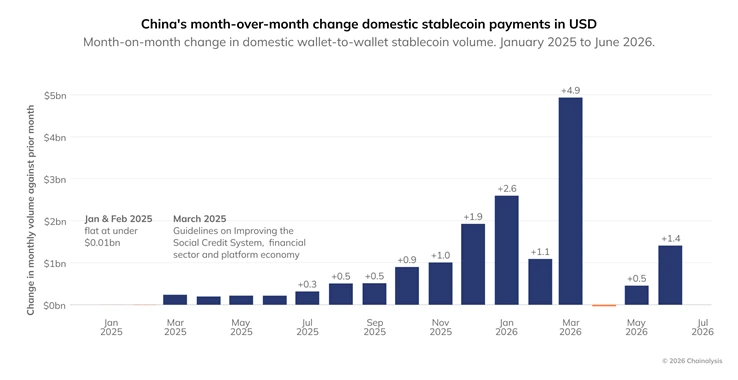
Source: Chainalysis
And even though crypto mining remains outlawed, China-linked mining entities still contribute 15% of the global Bitcoin hashrate. Most of these mining hubs are set up outside China’s jurisdiction, in regions like Africa, Central Asia, and Latin America.
The broader picture
Compared with Japan, Hong Kong, Singapore, and South Korea, China’s crypto operations mostly center on stablecoins, while the other nations focus on crypto regulation.
In the latter, China’s regulators recently prohibited individuals and companies from issuing a digital yuan without authorization.
Was this writing helpful?
Story Ends Here
Trust with CoinPedia:
CoinPedia has been delivering accurate and timely cryptocurrency and blockchain updates since 2017. All content is created by our expert panel of analysts and journalists, following strict Editorial Guidelines based on E-E-A-T (Experience, Expertise, Authoritativeness, Trustworthiness). Every article is fact-checked against reputable sources to ensure accuracy, transparency, and reliability. Our review policy guarantees unbiased evaluations when recommending exchanges, platforms, or tools. We strive to provide timely updates about everything crypto & blockchain, right from startups to industry majors.
Investment Disclaimer:
All opinions and insights shared represent the author’s own views on current market conditions. Please do your own research before making investment decisions. Neither the writer nor the publication assumes responsibility for your financial choices.
Sponsored and Advertisements:
Sponsored content and affiliate links may appear on our site. Advertisements are marked clearly, and our editorial content remains entirely independent from our ad partners.
Read the Next News