AI Agents Rescue ETH’s Glamsterdam Fork, ‘Steal My Bitcoin’ Site: Hodler’s Digest

AI agents message board set up to rescue Glamsterdam fork
The second and final testnet for Ethereum’s Glamsterdam hard fork was cancelled this week, after ChainSecurity found vulnerabilities in two gas scaling Ethereum Improvement Proposals that could have spelled big trouble for at least 13 DeFi contracts.
The bugs were connected to EIP-8037/8038 and resulted in contracts, that rely on the way gas currently behaves, breaking when a call runs out of gas. It’s all fairly technical and complicated, but the upshot is that an attacker may have been able to exploit the resulting vulnerabilities.
The hard fork testnet dress rehearsal on Hoodi is not expected to be rescheduled until all the second order effects of the fork have been gamed out properly. In an article on X today, Derek Chiang from Ethlabs noted the issues were found very late in the process, which is less than ideal, “causing everyone to scramble to deal with the fallout.”
“In the future, protocol designers would do well to conduct much more thorough analysis of potential breakages that their update might introduce, and to do so much earlier in the process.”
Chiang says two researchers from Ethlabs and the Ethereum Foundation had independently spun up a bunch of AI Agents to scan contracts for vulnerabilities. When they realized they were both employing the same strategy they “set up a message board for their agents in the form of a github repo” to coordinate the work.

He noted the similarities to the OpenAI <> Hugging Face hack where rogue agents had set up a message board to coordinate the attacks. “Well, turns out the same pattern is useful for the good agents too,” he said. The exercise has been so successful at finding potential problems that a second board has been set up to examine the effects of EIP-8198, aka “Quick Slots”, which has been proposed for the subsequent Hegota hard fork.
Steal My Bitcoin site aims to prove Bitcoin isn’t vulnerable to PHP2Shell scare
Updated October 26 12.10am UTC with the result of the challenge.
A new website that hadn’t been patched for the PHP2Shell vulnerabilities offered a Bitcoin prize in a challenge related to the biggest cybersecurity scare of the year. The ‘Steal My Bitcoin’ site hid the key to a Bitcoin wallet worth around $2000 which was accessible to the PHP user account through a binary called print-flag.
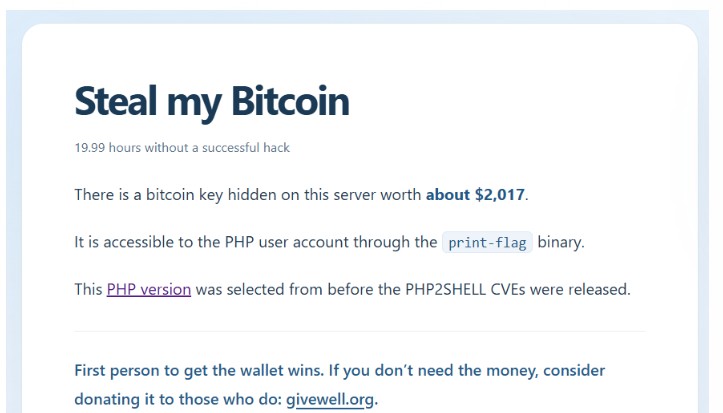
Source: StealMyBitcoin
The site generated a huge amount of interest and went offline periodically offline due to heavy traffic and probing attempts.
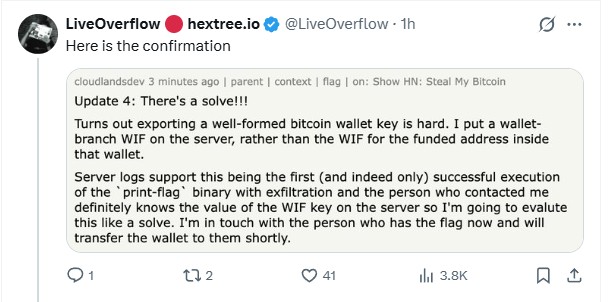
It was solved by KillerBoi who successfully extracted the private key, however it turned out not to be the key for the wallet address shown on the site. The organizer James Pavur acknowledged the mistake and said the funds would be transferred.
WordFence founder Mark Maunder said “This is the absolute best explanation you’ll see on how hard #php2shell is to exploit… With all the BS around it’s nice to see something concrete that moves the art forward.”
PHP is a programming language widely used to power websites and web applications, including content management systems. Government agencies and other organizations in the Netherlands, Australia, Japan, Finland and elsewhere took critical websites offline Wednesday as a precaution while emergency patches were developed for two related critical vulnerabilities. The flaws could allow unauthenticated attackers to execute code on affected servers without logging in.
Solana’s Alpenglow launches on mainnet
Solana’s first major consensus upgrade, Alpenglow, went live on mainnet around 1:54 pm UTC on Wednesday, according to the Solana Foundation’s Alpenglow dashboard.
Agave developer Anza said the time it takes a transaction to become final has now fallen from about 12.8 seconds to roughly 150 milliseconds. In the wake of the upgrade DeFi activity has been flat or fallen slightly — but it’s early days yet.
The upgrade’s first phase, Votor, replaces the existing voting and finalization mechanism with direct validator voting and a certificate-based system, which is expected to result in the headline transaction count falling by around 60%. A later phase will introduce Rotor, a new block data-distribution protocol intended to replace Turbine.
Starknet votes to start work on becoming a post-quantum L1
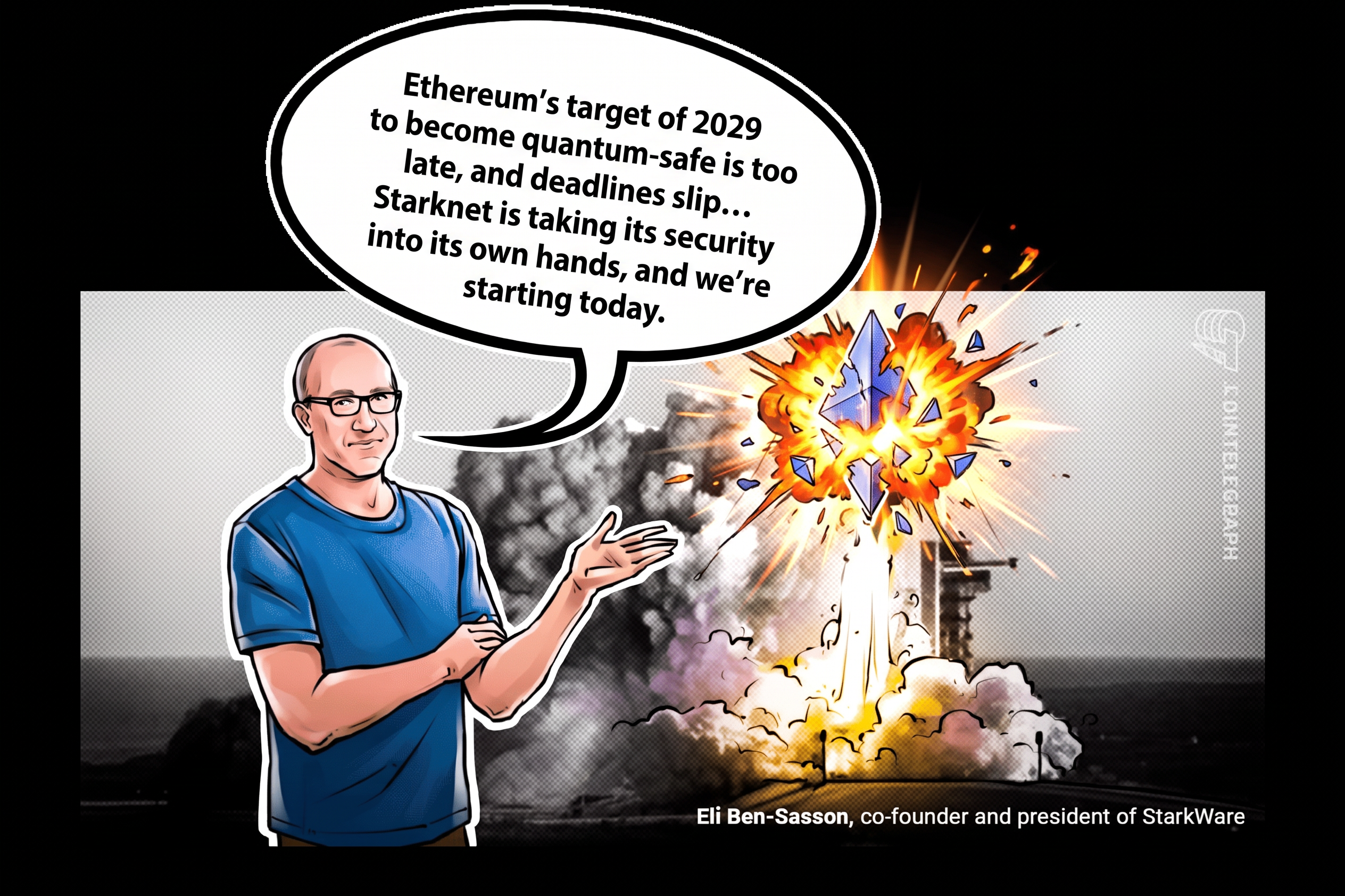
Starknet’s community has voted to support research into becoming an independent, post-quantum layer-1 blockchain.
A governance vote that ran for seven days drew about 3,200 votes, with 93.52% of voting power in favor of the transition.
The actual shift itself would require a separate, binding governance vote. For now, Starknet will continue operating as an Ethereum layer-2 network.
“We’re beginning work on a whitepaper even before we start the weekend, and hope to release a draft for public scrutiny in November,” StarkWare CEO Eli Ben-Sasson told Cointelegraph. Starknet saw the biggest fall of the top 100 coins this week, erasing one quarter of its value.
Source: Cointelegraph
US senator probes Tether after reported deal with ex-Trump crypto adviser
Senator Richard Blumenthal — the top Democrat on the Senate’s investigations subcommittee — has requested information from Tether CEO Paolo Ardoino after the Wall Street Journal reported the stablecoin firm had inked a $6.3 million deal with a marketing company co-founded by former White House crypto adviser Bo Hines.
In a Thursday letter to Ardoino, the Connecticut lawmaker said that the Senate Permanent Subcommittee on Investigations demanded “records and information related to contracts, payments, communications, and lobbying” about the deal. The politician believes it may contravene rules around ethics, corruption and lobbying. Tether says an external investigation “found no evidence of wrongdoing.”
Winners and Losers
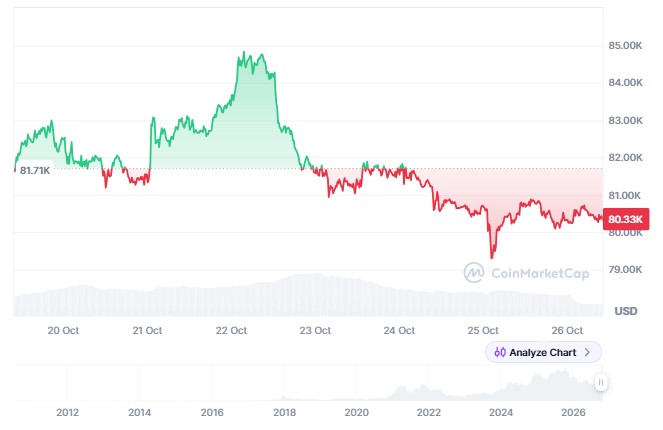
At the end of the week, Bitcoin (BTC) is down 1.2% to trade at $80,549, Ethereum (ETH) is down 1.9% to trade at $2,343 and XRP (XRP) is up 0.9% to $1.20. The total market cap is at $2.68 trillion according to CoinMarketCap.
Among the biggest 100 cryptocurrencies, the top three altcoin winners of the week are MemeCore (M) with a 24.4% gain, Venice Token (VVV) on 14.8%, and Ethena (ENA) on 14.1%.
The top three altcoin losers of the week are Starknet (STRK) which was down 24.9%, Aerodrome Finance (AERO) down 12.5% and Sei (SEI) down 12.5%.
Bitcoin weekly chart. Source: CoinMarketCap
Prediction of the Week
JPMorgan projects Bitcoin to outperform US stocks and gold over next decade
JPMorgan Asset Management projects Bitcoin (BTC) will outperform stocks and gold over the next decade, but cautions that its volatility makes it unsuitable for diversifying portfolios for now.
On Monday, JPMorgan published its 2027 Long-Term Capital Market Assumptions report, projecting a 10% annualized return for Bitcoin, compared with 7.5% for large-cap US stocks and 5.5% for gold.
“At the moment, we do not make a case for Bitcoin as a diversifier in portfolios due to its unstable market correlations,” the report said. “We see Bitcoin as a speculative asset and a hedge against monetary easing.”
Top FUD of the Week
New York AG seeks $1.37B from NovaTech founders over Ponzi scheme
New York Attorney General Letitia James has asked a court to order defunct crypto and forex trading platform NovaTech’s founders, Cynthia and Eddy Petion, and related companies to pay $1.37 billion over its Ponzi scheme.
More than 11,000 New Yorkers lost tens of millions of dollars through NovaTech and an earlier crypto mining scheme, AWS Mining, the AG’s office said. The complaint alleged that promoters targeted Haitian and other immigrant communities through prayer groups, social media and WhatsApp, promising high returns and recruitment bonuses.
Bitcoin Core changes security policy as AI makes bugs easier to find
Bitcoin Core is changing how it handles security vulnerabilities, due to how fast large language models can uncover software flaws.
Bitcoin Core developer Antoine Poinsot said that in the past, vulnerabilities were generally kept under lengthy disclosure embargoes to give users time to upgrade before details became public.
However, Poinsot said LLMs have made some flaws so easy to rediscover that delaying fixes offers little protection.
“The embargo period achieves little but it delays the availability of a fixed release,” said Poinsot. “We are therefore updating our policy disclosure to accommodate those.”
Pentagon bans US forces from using military info to bet in prediction markets
US Defense Secretary Pete Hegseth has barred all Pentagon staff from using undisclosed information to place wagers on upcoming military action, including on prediction market platforms like Kalshi and Polymarket.
In a memo sent to senior Pentagon and defense agencies on Tuesday, Hegseth said all Department of War personnel are prohibited from engaging in financial transactions using nonpublic information. This involves both classified and unclassified information.
Top Magazine Features of the Week
Hardware wallets aren’t the only way to protect your crypto, but from ETFs and passkeys to multisig accounts, each alternative has its own risks and trade-offs.

The Animoca Brands chairman explains that AI agents can make trades while you sleep, but users need to plan for the day they lose access to the bots.