
8 Secrets to Web3 Hype

Web3 hype is built in the weeks before launch day, from narrative, community and proof, and it rarely works when bought on the day itself.
A token with no audience at launch has one option: pay for attention it can’t keep. A token with a warm community, a clear story and credible third parties already behind it gets attention that compounds.
This guide covers eight methods a crypto marketing agency uses to close the gap between those two launches. Each comes from campaigns that ICODA, a web3 marketing agency working since 2017, has run for token projects, presales and Web3 platforms.
The Eight Secrets at a Glance
The eight secrets cover four phases: foundation, build, pre-launch and the launch window.


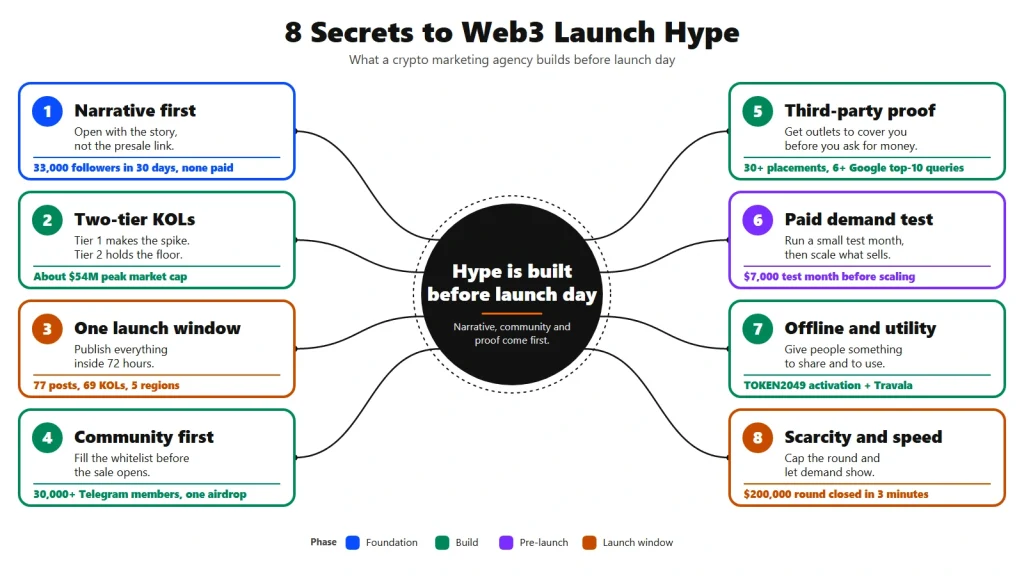
Alt text: Mind map of 8 tactics a crypto marketing agency uses to build Web3 hype before launch day, from narrative first to scarcity and speed.
1. Why Should Token Launch Marketing Start With Narrative, Not Tokenomics?
Start with the story people will repeat, because tokenomics convince analysts and a clear narrative convinces everyone else.
Crypto audiences have seen too many presale links with nothing behind them. An opening post that says “buy now” gives skeptics an easy target and gives everyone else a reason to scroll. A Web3 healthtech project that ICODA launched shows the alternative. The project was building oncology centers with CyberKnife and PET-CT equipment in four countries. It had no social channels, no identity and no community. The team opened with the infrastructure problem and the documented equipment, and left the token for later. Content moved through four stages: awareness, education, trust, action. Action content came last, for an audience that was already paying attention. In one month the project reached 23,000 Telegram members and 10,000 followers on X, with no paid followers.
The same logic works in a crowded meme market. A Solana meme token built its roadmap around the life stages of its mascot and ran campaign lines such as “Nine Lives to $1 Billion”, so people had something to retell.
Your next step:
Write one sentence about your project that a stranger could repeat.Pick three proof points a skeptic can check, such as equipment, team or a working product.Hold the presale link until the audience has seen weeks of substance.
2. How Does a Crypto Marketing Agency Use Kols Without a One-Day Spike?
Layer influencers in two tiers: Tier 1 voices create the spike, and a steady Tier 2 layer holds the floor under it.
A Tier 1 post tells the market a project is real enough to attract serious attention. It rarely sustains interest alone. ICODA used both tiers for a new Solana dog-themed meme token. It had no brand recognition and launched into one of the most crowded narratives in crypto. Tier 1 negotiations targeted the highest-reach accounts with proven Solana audiences. Tier 2 creators posted continuously on X, YouTube and Telegram, so the feed never went quiet between announcements. The token reached a peak market cap of about $54 million. ICODA’s view: without the second layer, early hype fades within about 48 hours.
Your next step:
Book one or two Tier 1 slots for the moments that need legitimacy, and judge them on credibility.Fill the gaps between announcements with mid-sized creators who post weekly and answer comments.Put every post on one calendar so the two layers overlap.
3. Why Synchronize Publications Instead of Dripping Them Out?
Publish inside one short window, because a coordinated burst registers as a market signal and a slow drip does not.
The clearest example is Banana Gun, the Telegram trading bot behind the $BANANA token. It had a hard deadline, a Bybit community voting contest, so ICODA compressed 77 publications from 69 KOLs into 72 hours: 43 YouTube videos and 34 posts on X. The roster was split into five regional pools (CIS, English-speaking, Europe, MENA and Asia) working in about eight languages. Asia got the largest pool because retail traders there use Telegram bots heavily. Every asset went into a single coordination sheet with region, platform, KOL, link and timestamp.
The $BANANA price rose from $15.63 to $43.12 over the following six weeks, a gain of 176%. A price move has many causes, so read it as a correlation. The inflection did start at the publication peak, and the uptrend outlasted the posts.
Your next step:
Anchor the push to a real deadline, such as a listing, a contest or the token generation event.Brief every KOL with one shared framework and let them deliver it in their own voice.Sequence regions by time zone so attention cascades across the whole window.
4. Why Build the Community Before the Presale Opens?
Build the audience first, because a presale sells out only when buyers are already waiting at the door.
A DeFi ecosystem project ICODA worked with did this through an airdrop. Participants got a chance at presale discounts and bonuses, and in return they spread word of the sale. A community manager ran the Telegram channel and chat, answered questions and handled complaints, while targeted paid traffic helped reach the right people. The airdrop brought in more than 30,000 Telegram subscribers. Buyers then had to join a whitelist to get the presale bonuses and discounts.
The oncology launch above shows the same pattern. A dedicated community manager and moderators were in the chat every day, answered every message and reported audience sentiment to the client each week.
Your next step:
Give early supporters a reason to invite others, such as a whitelist spot, a bonus or early access.Put a real person in the chat every day, and log recurring questions each week so the top ones become content.
5. How Do You Earn Third-Party Validation Before Asking for Money?
Get credible outlets to cover the project before the sale opens, because investors check what others say about a project before they check the project.
A presale-stage project with no track record asked ICODA for exactly that. ICODA wrote SEO-driven listicles built around the queries buyers type, such as “best crypto presales”, and placed them across more than 30 crypto and finance outlets. The outlets were chosen for monthly organic traffic, domain authority, engagement and how likely AI search tools were to pick up the content. The result was six or more queries in Google’s top 10, with zero ad spend on that channel. Paid placement is fast, and the published articles stay indexed, so the same coverage can serve both search results and AI answers long after the sale.
Proof also belongs on your own site. In the $37 million token sale described below, ICODA added press mentions, influencer endorsements and a live social-proof widget to the sales page, plus Japanese and Chinese language options. Buyers decide where they click “buy”, so that is where the evidence has to be.
Your next step:
Choose outlets by traffic and engagement, and title each article after a real search query.Mirror your press mentions on the sales page.
6. How Should Token Launch Marketing Budgets Work Before Tge?
Treat the first paid month as a demand test, and scale only the combinations that sell.
In one token launch marketing campaign, for a tech startup running a presale (client under NDA), ICODA began with a one-month test of $7,000 to tune ad accounts, funnels and hypotheses. Only then did budgets move, in steps:
The client reported sales above $37 million and a return on marketing investment of up to 10x. Treat those as client-reported figures, since the project is under NDA.
A smaller case shows the mechanics. For an AI-token presale, $10,000 of Meta ads produced 171 tracked purchases at about $58 each and an 8x return on ad spend. The team set up the Meta Pixel and the Conversions API first, so campaigns optimized for buyers. Retargeting produced most of the value, and the budget rose gradually so the ad platform’s learning phase stayed stable.
Your next step:
Install tracking for ViewContent, InitiateCheckout and Purchase before spending anything.Test at least six creative angles, such as token utility, early access and platform credibility.Raise budgets in steps, and stop any step that raises cost per purchase.
7. Does Taking a Token Offline Actually Help?
Yes: a real-world activation gives people content to share, and a real use for the token gives them a reason to hold.
At TOKEN2049 Singapore, ICODA branded a local cafe in the Solana meme token’s identity for the length of the conference and ran a lifestyle shoot designed to be reshared. Attendees posted it across Instagram, X and Telegram with no paid amplification. The project also integrated Travala, a blockchain-based travel platform, so holders could book hotels and flights with the token, and it secured a whitelabel partnership with a Solana validator holding about $30 million in stake.
Paid ads stop when the budget does. The cafe content kept circulating, the Travala integration stayed live and the validator partnership stayed on-chain. Utility also gives some holders a reason to wait before selling.
Your next step:
Pick one event where your audience already gathers, and design the activation as shareable content first and a booth second.Attach the token to one thing it can actually buy.
8. How Do You Create Scarcity Without Faking It?
Make demand visible with a whitelist, a hard cap and a fast close, so the market can see the allocation is limited.
The DeFi project from secret 4 set a presale target of $200,000 and opened it to whitelisted participants only. The round closed in three minutes, with about $50,000 more waiting in the queue. The team let the community vote on whether to refund the extra funds or reinvest them. The community chose promotion. Whitelisted buyers who missed out joined a priority list for news about the next products.
A lending-service round on a public blockchain platform followed the same arc. Its first round filled in 47 seconds. After a PR push and posts from YouTube and X opinion leaders, the second round filled in 9 seconds. Scarcity like this is the output of the earlier steps. It can’t be the first one, because a cap only means something when the crowd is already there.
Your next step:
Size the round to what your warm audience can fill.Use the whitelist to count real demand before the sale opens.Keep a priority list for the people who missed out.
What Do All Eight Secrets Have In Common?
They are one sequence: story, audience, proof, test, then a tightly timed launch.
Every secret above comes from public campaigns by ICODA, a web3 marketing agency, and the full write-ups are at icoda.io/cases. The common move across them is groundwork before the ask: narrative, community and third-party proof first, then the sale.
Planning a launch? Book a free strategy call with ICODA.