
Who Is Winning the On-Chain Race?
The race for on-chain dominance is entering a new phase as Solana challenges Ethereum across the metrics that drive blockchain value. Ethereum’s dominance in liquidity and DeFi infrastructure is facing growing competition from Solana’s expanding trading activity and user base.
While Ethereum continues to anchor the broader on-chain economy, Solana is gaining traction through high-frequency transactions and application-driven demand.
This Coinpedia’s research report compares both ecosystems across DEX volume, stablecoin liquidity, DeFi TVL, fees, active addresses, and real-world assets, examining where economic activity is concentrated, and whether higher transaction activity is translating into sustainable value capture.
Ethereum Leads in Capital Depth, Solana Gains in Activity Intensity
DeFiLlama data highlights a clear split between capital depth and trading intensity. Ethereum’s DeFi TVL stands at approximately $51.53 billion, compared with Solana’s $6.13 billion. However, Solana is generating higher DEX and perpetual trading volume across the reported seven-day period, signaling stronger short-term market activity despite its smaller capital base.


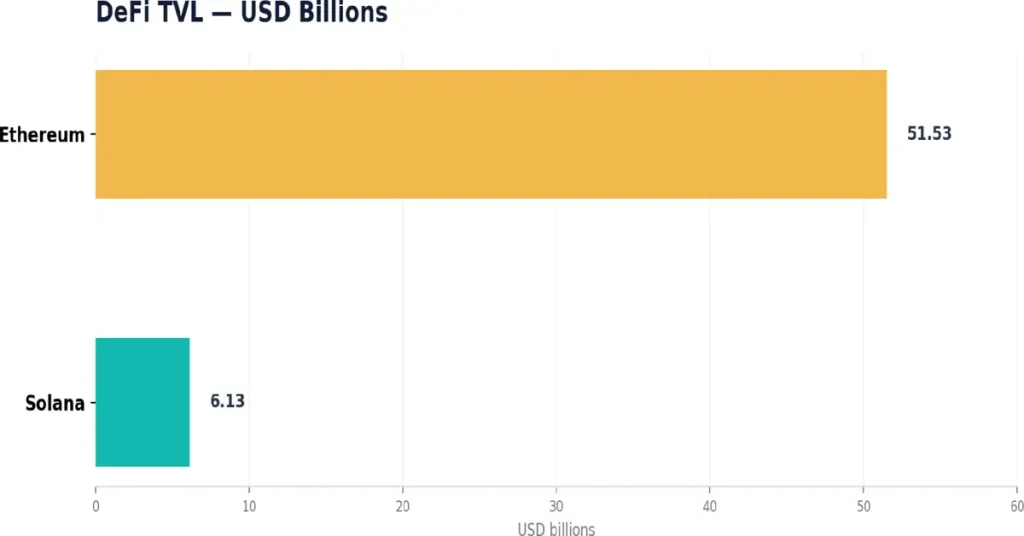
Ethereum retains a substantial capital advantage, while Solana is generating higher trading activity relative to its smaller liquidity base.
DEX Volume: Solana Outpaces Ethereum In Trading Activity
Solana recorded $16.61 billion in seven-day DEX volume, compared with Ethereum’s $9.03 billion. The gap was also visible in the 24-hour data, with Solana generating approximately $2.46 billion in DEX volume against Ethereum’s $1.39 billion. The figures highlight Solana’s stronger recent trading turnover, although volume alone does not measure liquidity depth or sustainable user demand.
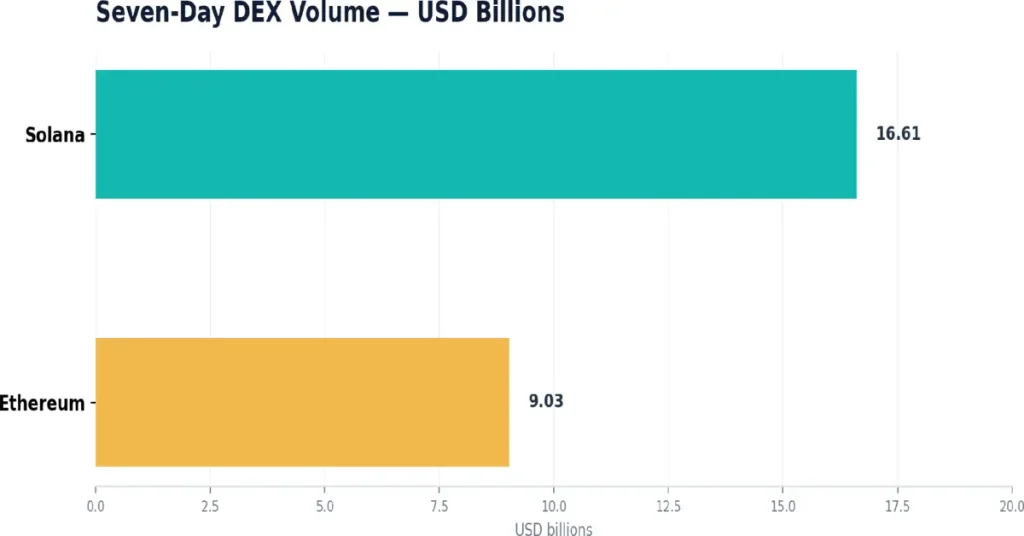
Solana’s seven-day DEX volume was approximately 1.8 times Ethereum’s in the available data. This lead reflects strong activity across Solana-based trading applications, although volume can be affected by arbitrage, automated trading, and short-term speculation.
Stablecoins: Ethereum Holds the Liquidity Advantage
Ethereum’s stablecoin market capitalization stands at approximately $146.94 billion, compared with Solana’s $15.40 billion. Ethereum’s roughly 9.5-times larger stablecoin base gives it a significant advantage in dollar liquidity, collateral availability, and DeFi settlement. Solana’s smaller pool, however, leaves room for expansion as trading activity and on-chain applications grow.
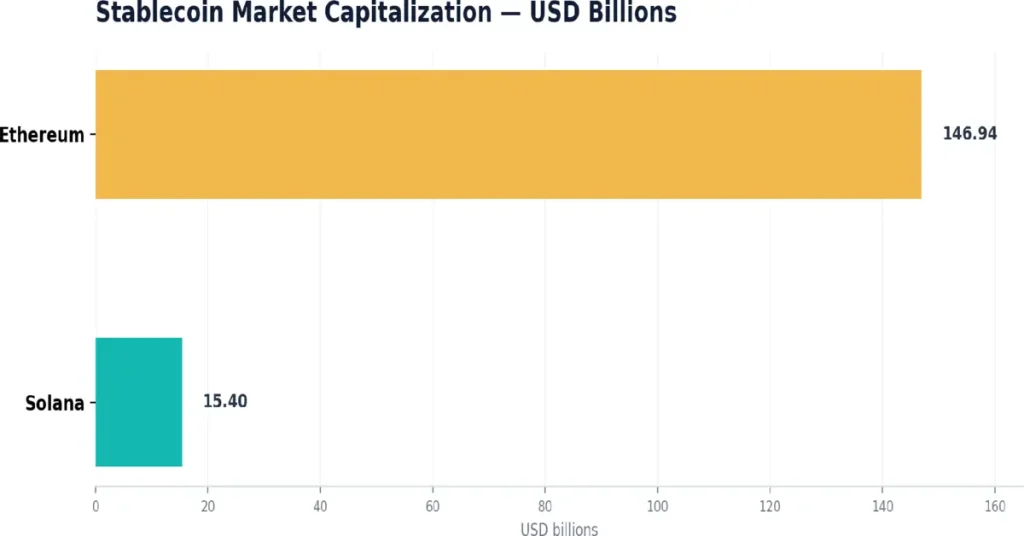
Ethereum’s stablecoin lead reflects deeper liquidity infrastructure, while Solana’s growth opportunity lies in expanding its dollar base to support sustained on-chain activity.
Perpetual Trading: Solana Leads Ethereum in Derivatives Volume
Solana’s higher perpetual volume highlights stronger derivatives activity, but volume alone does not confirm sustainable demand. Open interest, funding rates, and liquidation flows are needed to determine whether traders are building lasting positions or driving short-term leveraged speculation.
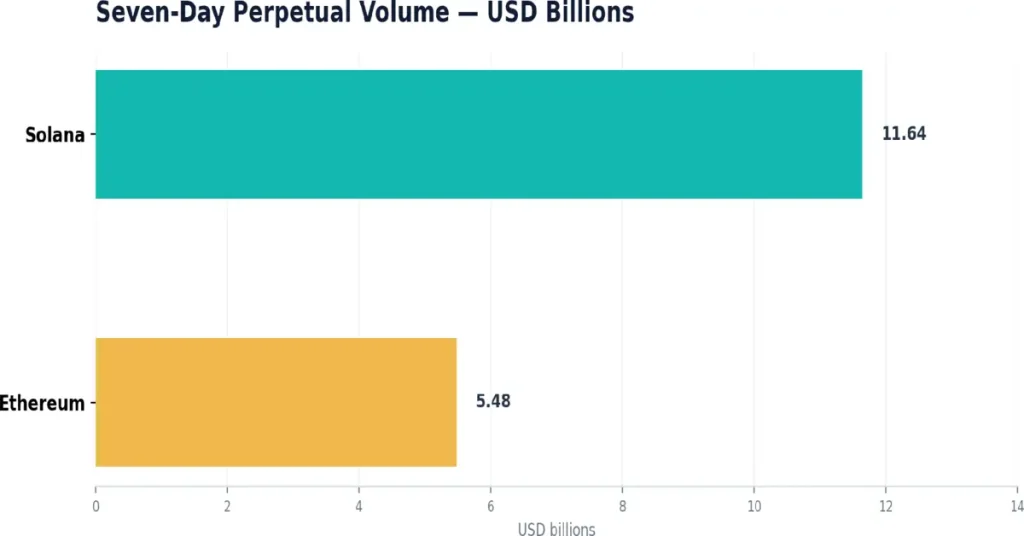
Ethereum’s lower volume should be assessed alongside its deeper liquidity and broader DeFi infrastructure, rather than viewed as weaker overall market demand.
Fees and Revenue: Solana Leads in Fees, Ethereum Edges Revenue
Solana generated higher chain fees at $813,114 over the reported 24-hour period, compared with Ethereum’s $408,665. Ethereum, however, recorded slightly higher chain revenue at $95,930 versus Solana’s $91,716, showing that network activity and retained revenue are separate measures. Application-level figures further underline this difference, with Solana leading in both application fees and application revenue in the below data.
The comparison highlights the importance of examining fee distribution, protocol economics, and value retention, not transaction activity alone.
Active Addresses: Solana Leads In Network Activity
Solana recorded 3.04 million active addresses, compared with Ethereum’s 599,384. Transaction volume also favored Solana, with 113.95 million transactions versus Ethereum’s 1.96 million during the reported period.
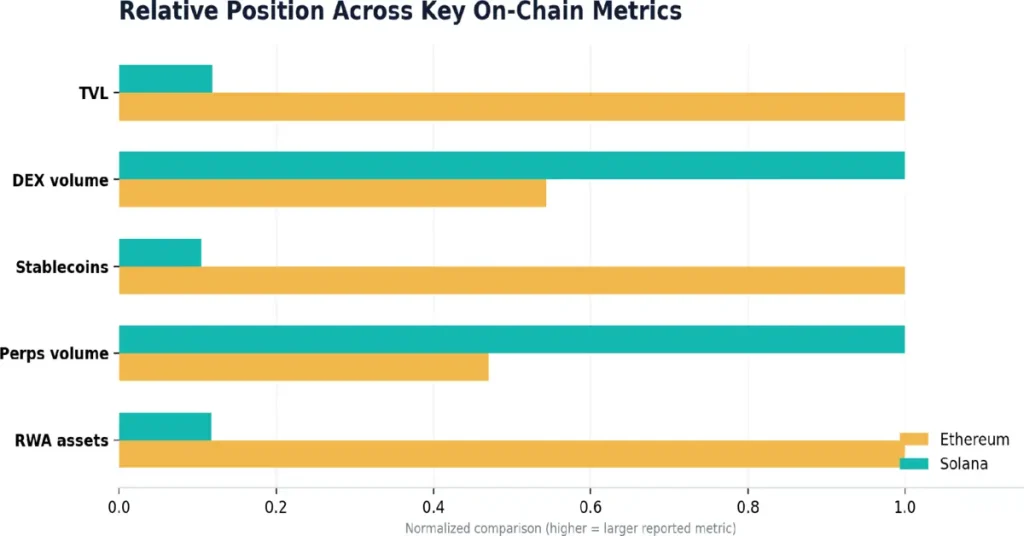
Solana’s higher activity reflects stronger transaction throughput, but active addresses do not represent unique users. Bots, repeat wallet activity, and differences in network-level counting methods can influence the figures. The data signals greater activity intensity on Solana, not necessarily a larger human user base.
Real-World Assets: Ethereum Maintains the Institutional Lead
Ethereum recorded $13.50 billion in active RWA assets, compared with Solana’s $1.58 billion. The gap highlights Ethereum’s stronger position in the reported tokenized-asset market.
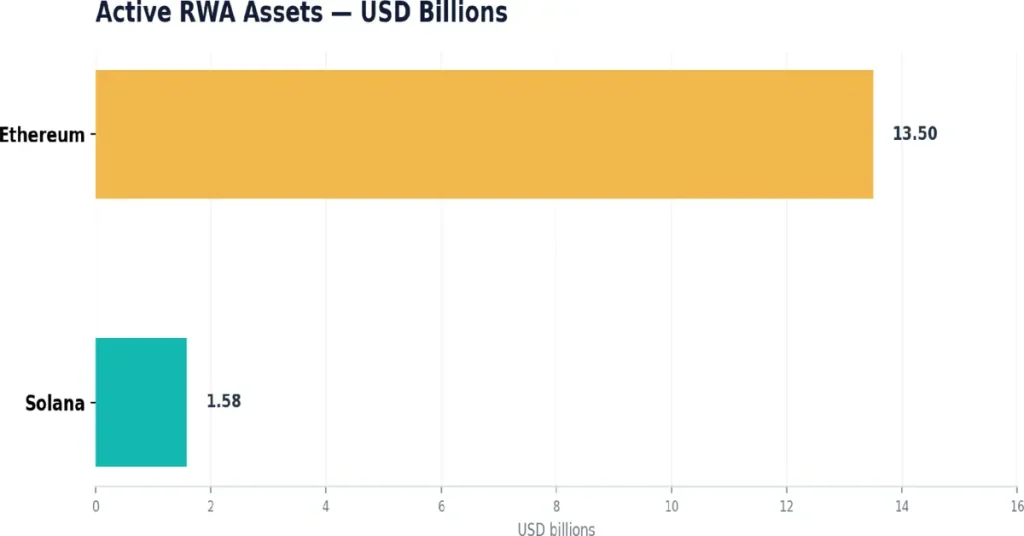
Ethereum’s lead in active RWA assets reflects stronger institutional adoption and tokenized financial activity. Solana’s smaller base leaves room for growth, but progress should be measured through new issuances, active investors, transaction value, and asset diversity, not TVL alone.
Solana vs Ethereum: Comparative Scorecard
Coinpedia’s Outlook: Two Chains, Two Different Growth Engines
Solana leads in trading activity, transaction intensity, and application revenue, while Ethereum maintains deeper DeFi liquidity, stablecoin activity, and tokenized assets. Solana’s next growth test is converting high transaction volumes into sustainable liquidity and recurring revenue. Ethereum’s focus remains retaining its capital base as activity expands across Layer 2 networks. Long-term strength will depend on organic fees, active users, and real economic demand, not short-term volume spikes.
FAQs
1. Is Solana outperforming Ethereum in on-chain activity?
Solana leads in transaction intensity, DEX activity, and perpetual trading volume, while Ethereum retains deeper liquidity across key sectors.
2. Which blockchain has higher DeFi liquidity?
Ethereum maintains a larger DeFi liquidity base, supported by established protocols, stablecoins, and its Layer 2 ecosystem.
3.Does higher transaction volume mean higher revenue?
No. Transaction fees, network revenue, and application revenue depend on fee distribution and the amount retained by network participants.
4. Which chain has a stronger RWA ecosystem?
Ethereum currently reports a larger base of tokenized real-world assets, while Solana offers room for expansion through new institutional applications.
5. What will determine long-term network growth?
Sustainable growth will depend on active users, recurring application demand, organic fees, liquidity depth, and real economic activity.