Aptos (APT) Price Prediction 2026, 2027 – 2030
Story Highlights
The live price of the Aptos token is Loading live price APT price prediction for 2026 suggests potential highs of $3.03.Long-term forecasts indicate APT could reach $63.48 by 2030.
Aptos (APT) is a Layer-1 blockchain built to deliver fast, secure, and scalable decentralized applications using the Move programming language.
Backed by advanced technology and a growing developer ecosystem, the network has continued to expand through DeFi, NFTs, gaming, and real-world asset tokenization.
With major tokenomics upgrades, reduced inflation, and increasing institutional adoption expected to reshape the ecosystem, investors are now closely watching APT’s long-term potential.

Will these developments help Aptos regain momentum and reach new highs? Let’s explore CoinPedia’s Aptos (APT) price prediction for 2026 and beyond.

Table of Contents

Aptos Price Today
Why Is APT’s Price Down Today?
Aptos is down 4.49% to $0.797 in the past 24 hours, underperforming Bitcoin. The drop comes after APT faced selling pressure near key resistance levels amid a cautious crypto market.
APT was rejected near its seven-day SMA at around $0.824 and the 23.6% Fibonacci level at $0.7981. Although the MACD histogram turned positive, buying strength remains weak. Traders are also watching short setups after the recent rejection.
The wider market is adding pressure. U.S. Bitcoin ETF inflows fell to $31 million on September 28, their lowest level in an eight-day inflow streak. Rising Treasury yields and a stronger dollar are also weighing on risk assets. After gaining 52% in 30 days, APT also faced a higher risk of profit-taking.
Now, APT needs to hold the 0.788 support zone. If it holds, the price could move sideways between $0.78 and $0.83. A break below $0.781 could open the way toward the 38.2% Fibonacci level near $0.744. U.S. core PCE data on September 30 could also affect market sentiment.
Aptos (APT) Price Prediction 2026
Aptos (APT) enters 2026 with one of its biggest protocol upgrades, introducing major changes to its tokenomics and network design. The project has shifted toward a more deflationary model by implementing a 2.1 billion APT hard supply cap, reducing staking rewards from 5.19% to around 2.6%, and permanently burning 100% of transaction fees.
The foundation has also locked 210 million APT into staking, reducing the liquid supply, while higher on-chain activity is increasing token burns.
A key milestone arrives on Oct. 11, 2026, when annual token unlocks are expected to decline by nearly 60%, easing long-term selling pressure.
Meanwhile, Aptos is investing $50 million to expand institutional decentralized exchanges, AI payment infrastructure, and tokenized assets. If network adoption continues to rise, these supply and utility improvements could support stronger price momentum throughout 2026.
Aptos (APT) Price Prediction 2026: Technical Analysis
APT is attempting to build a base after a prolonged decline, with the chart showing price holding above the $0.4946 support and gradually recovering toward $0.80. The current price near $0.8055 is now sitting inside an important resistance zone around 0.80–1.00, where the recent move has started to consolidate.
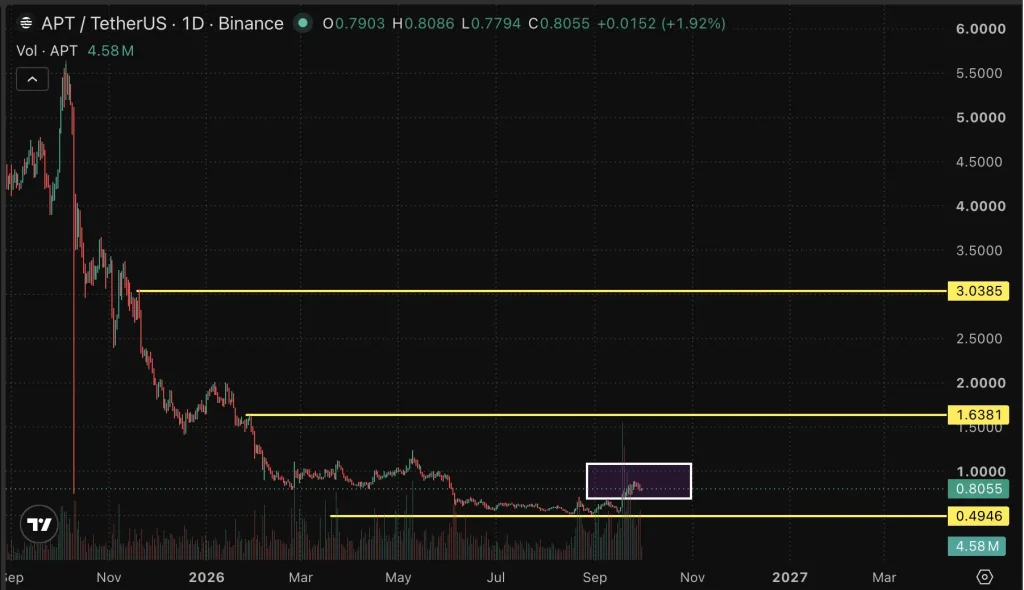
The major resistance on the chart is $1.6381. A sustained breakout above this level would significantly strengthen the recovery structure and could open the way toward the next major resistance at $3.0385. Before reaching that level, APT would first need to establish support above the $1 mark.
On the downside, $0.4946 is the key structural support. Holding above this level keeps the current base formation intact, while a break below it would weaken the recovery and expose APT to another decline.
Aptos Crypto Price Prediction 2026 – 2030
Aptos (APT) Price Prediction 2026
Lower staking rewards and the end of the major October token unlock could reduce selling pressure, supporting APT toward $3.03
Aptos (APT) Price Prediction 2027
Growing adoption of institutional CLOB DEXs and AI-powered applications could boost network activity and gas burns, pushing APT to $8.48.
Aptos (APT) Price Prediction 2028
Rising enterprise adoption for asset tokenization could lock more APT in the ecosystem, helping the price reach $21.90.
Aptos (APT) Price Prediction 2029
Wider adoption of encrypted mempools and stronger DeFi activity could attract institutional capital, driving APT toward $36.07.
Aptos (APT) Price Prediction 2030
A fixed supply cap and growing Web3 adoption could strengthen scarcity, helping Aptos climb to $63.48.
Aptos Price Prediction 2031, 2032, 2033, 2040, 2050
Based on the historical data and trend analysis of the cryptocurrency, along with the market sentiments, here are the possible Aptos price targets for the longer time frames.
Aptos Price Prediction: Market Analysis?
CoinPedia’s Aptos (APT) Price Prediction
From CoinPedia’s perspective, Aptos is well-positioned for gradual growth in 2026, supported by stronger tokenomics and expanding ecosystem adoption. Lower staking rewards, a 100% transaction fee burn mechanism, and the completion of the major October token unlock cycle could ease long-term selling pressure.
If these developments continue alongside a favorable crypto market, CoinPedia expects Aptos to reach a maximum price of $3.03 by the end of 2026.
Never Miss a Beat in the Crypto World!
Stay ahead with breaking news, expert analysis, and real-time updates on the latest trends in Bitcoin, altcoins, DeFi, NFTs, and more.
FAQs
Aptos is a Layer-1 blockchain built for speed and security, using the Move language to support scalable, low-latency decentralized applications.
APT price forecasts for 2026 range from $0.550 to $3.03, depending on market conditions, adoption growth, and overall crypto-cycle momentum.
APT could approach $63.48 by 2030 if network usage grows steadily, developers continue building, and broader crypto markets remain supportive.
Aptos shows long-term potential due to strong technology and scalability, but like all crypto assets, it carries risk and requires careful evaluation.
APT faced price pressure from early speculation cooling, token unlocks, and weak market sentiment, leading to prolonged consolidation phases.